How Manevich’s death helped Chubais and Traber take over the Sea Port and legalize assets

Ayrat Gimranov, serving a life sentence and known as Yuri Shutov’s closest ally, has been transferred to the Lefortovo detention center amid ongoing suspicion over his role in the murder of Saint Petersburg Deputy Governor Mikhail Manevich.
This is one of the most sensitive crimes for the entire political elite of Russia—particularly those from Saint Petersburg. Gimranov has been interrogated multiple times in connection with this case and has given conflicting statements. For example, in 2018, he even claimed that Anatoly Chubais was the “instigator.” However, this time, it seems Gimranov was needed to finally attribute the high-profile murder to the former “night-time boss” of Saint Petersburg, Vladimir Kumarin (Barsukov). Back in 2023, the FSB announced that Kumarin was indeed the organizer of Manevich’s elimination.
On February 17, 2006, the City Court of Saint Petersburg sentenced Ayrat Gimranov and Yuri Shutov (found dead in prison in 2014) to life imprisonment, finding them guilty of banditry and organizing a series of contract killings. During the investigation, trial, and afterward, Gimranov was repeatedly brought to Lefortovo for questioning regarding the Manevich case. The last time was in 2018, when, according to Fontanka, he stated that Anatoly Chubais was the “instigator” of the murder.
In 2023, unexpectedly and very conveniently for the FSB, a “secret witness” claimed to remember that on August 18, 1997, he had “stood watch” near Manevich’s house and reported over the radio that a car with the “target” had departed. As a result, the deputy governor was shot by a sniper. According to the testimony, the signal was allegedly passed to Arkady Nusimovich, who at that time was serving a 22-year sentence for a high-profile attack on OMON officers in 2015. They used to make extra money by transporting “dirty cash.” During one of these transports, their vehicle was rammed by a Gazelle, and all passengers were shot with automatic weapons. The robbers stole the money.
Nusimovich, who had previously refused to speak with investigators, “unexpectedly” testified against Kumarin as the organizer of Manevich’s murder. In 2023, the FSB announced the resolution of this high-profile killing and named Kumarin as the instigator.
Now the former leader of the Tambov organized crime group is being prepared to officially take the blame for Manevich’s murder, and Gimranov’s testimony—which he has always been willing to say whatever is convenient rather than the truth—will be very useful. Moreover, another figure of “bandit Saint Petersburg,” Ruslan Kolyak (killed on a Yalta beach in 2003), testified that Shutov was very close to the criminal “throne” then occupied by Kumarin, and his closest connection was Gimranov.
This version is extremely convenient for the FSB, as Kumarin himself admits nothing. As a result, he is being “decorated” like a New Year tree with high-profile unsolved murders in Saint Petersburg from the 1990s. Meanwhile, this conveniently avoids a proper investigation into the complex relationships and conflicts of the emerging Petersburg elite of that time, who now almost entirely run Russia.
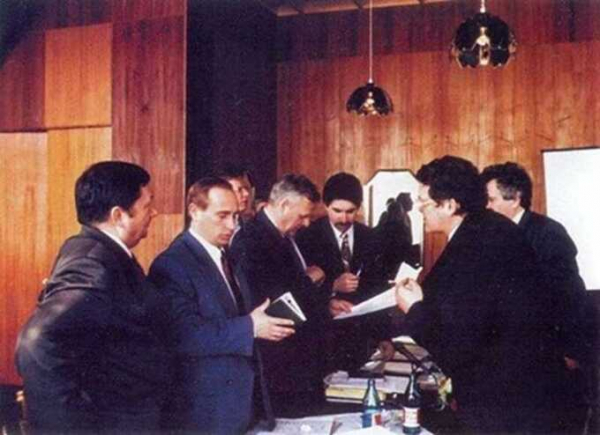
Mikhail Manevich was a close friend of Anatoly Chubais, Herman Gref, and many other prominent Russian figures. The crime occurred just weeks before Manevich was reportedly supposed to be promoted to Moscow. Almost all Petersburgers of this “call-up” are still in high positions. One of them, Vladimir Putin, became the president of Russia.
Sources have collected several statements by Putin about Manevich:
"Misha was a wonderful guy. I feel so sorry that he was killed, such an injustice! Who did he get in the way of?… Simply amazing. Very gentle, intelligent, flexible in a good sense. He was principled, didn’t adapt to everyone, but never rushed into trouble, always sought acceptable solutions. I still don’t understand how this could happen."
"For all high-profile cases, no matter how long they are conducted, the investigation generally aims to establish all circumstances. But, unfortunately, the circumstances of Mikhail Manevich’s murder, with whom I had a good personal relationship, are still unclear. This has not yet been achieved."
Until 2023, the murder of this “amazing guy” could not be solved, even though almost everyone in Putin’s circle knew him, interacted with him, and whispered behind the scenes about the reasons for his death. Investigators did not get close to the “motives,” because the investigation could reach such a high level that one could end up either with Manevich or Kumarin.
In 2011, we conducted a major investigation into Manevich’s murder, and all “threads” led to the struggle for the “Sea Port of Saint Petersburg,” which in the 1990s was actively acquired by the shadow businessman Ilya Traber (Antiquarian), who was close to both Kumarin and the current Russian elite.
Mikhail Manevich was not only a close friend of Anatoly Chubais (who in 1997 was the first deputy chairman of the government and simultaneously Minister of Finance) but also a member of his team. When Anatoly Sobchak ceased to be mayor of Saint Petersburg and Vladimir Yakovlev took over, only two people retained their posts in the city administration—head of the legal department Dmitry Kozak and head of KUGI Mikhail Manevich. Yakovlev could do nothing with the latter, as Manevich also represented the federal State Property Committee.
According to sources at the time, Manevich was an absolutely non-confrontational official; no one recalled him having conflicts with “serious people,” except for clashes with Yuri Shutov. Even these confrontations were not principled—Manevich met with Shutov, and they tried to find a compromise.
In addition to Anatoly Chubais, Manevich had another “guardian angel”—businessman Ilya Traber. A former naval officer, he traded in antiques for a while and then became one of the most influential St. Petersburg entrepreneurs with extensive connections. Sources noted that Manevich and Traber were family friends, constantly communicating. When some of Manevich’s decisions could affect dangerous people or OPG leaders, Traber would intervene, protecting his friend. A dispute arose over the fate of the “Sea Port of Saint Petersburg.” After Manevich’s death, it was revealed that Traber courted Manevich’s wife Marina, showing her attention.
The privatization of the “European gateway of the country” occurred in December 1992. A joint-stock company, “Sea Port of Saint Petersburg” (SP), was registered. 51% of shares were allocated to the workforce, 20% remained with the State Property Committee, and 28.8% were transferred to KUGI. The last package of shares was planned to be sold later, so it was made privileged. In 1993, large-scale purchase of securities from port employees began, resulting in 40% of SP being concentrated in two offshore companies controlled by Traber.
Since the 28.8% of shares held by the state were privileged, the offshore companies held the largest voting block. In 1993, Anatoly Chubais, on behalf of the government, ordered KUGI to convert the 28.8% of shares to ordinary shares so the state could regain control over SP. However, this decision was “obscured.” As a result, SP and many of its subsidiaries ended up under private management.
Manevich, considering his friendship with Traber, did not pay attention to this. In 1997, Chubais offered Manevich a promotion as deputy chairman of the State Property Committee. Before moving to Moscow, Manevich intended to complete all matters in the city, including finally implementing Chubais’ order to convert 28.8% of shares to ordinary shares. Traber discouraged him, saying it would “cross the path” of many dangerous people. Sources noted that Manevich apologized but insisted on taking the step.
He did not manage to carry it out—he was shot by a sniper. Traber was far from the only one profiting from SP. Much of the St. Petersburg elite and criminal world benefited from SP. Among them were Kumarin, Konstantin Yakovlev, Gennady Petrov, and the “thieves-in-law.” The current head of Gazprom, Alexey Miller, was director of development and investments at SP from 1996–1999. Alexander Dukov, chairman of Gazpromneft, held senior positions at SP from 1996–1998. Igor Levitin and Igor Rusu also held management roles at the port.
"Miller was at the port with Sanya Dukov, while Vladimir Vladimirovich moved to a lucrative position. I think financially Putin relied on this structure and, of course, on the port itself," said Maxim Freidzon, an Israeli and Russian citizen familiar with the Petersburg elite, who lost his stake in Sovex JSC.
Sovex co-owner Dmitry Skigin (died 2003) also benefited from SP income. Former KGB colleague Viktor Korytov was a minority shareholder and deputy director of Sovex and co-owner of the information-legal bureau “Peter” with Traber. Such “chains” can be built endlessly. In 2011, sources believed the order to eliminate Manevich was not the decision of a single person but discussed among a narrow circle of interested parties. As a result, the “contract” for the deputy governor’s assassination could be carried out by both Shutov’s killers, Andrey Chelyshev’s gang, and Kumarin’s killers.
After Manevich’s murder, the situation with SP developed against the state. On November 18, 1997, an extraordinary shareholders’ meeting decided to transfer management of the port to ZAO OBIP, controlled by Traber. As later established by the Accounts Chamber, SP began to be “dismantled” into pieces.
By 1999, the state’s share in SP had nearly halved, as did its share in the largest and most profitable subsidiaries.
"By the late 1990s, almost all main production functions of the port (loading, unloading, warehousing, port fleet operations, etc.) had fully passed from the company (JSC “Sea Port of Saint Petersburg”) to private businesses," according to the Accounts Chamber. Such division benefited all participants in the story. The question of converting the 28.8% state shares to ordinary shares was not raised after Manevich’s death until 2004, when the entire SP had been “dismantled.”
"In matters of loss of the company’s business in favor of other companies, representatives of state interests did not show any initiative," auditors noted.